
One of the most popular word games of all time, Scrabble has established itself as a cultural phenomenon loved by players of all ages since its initial mass production in the late 1940s. Initially invented as a passion project by Alfred Mosher Butts, the game was developed to feature a simple, competitive word-building concept that players can enjoy again and again.
Table of contents:
- History of Scrabble
- Popularity of Scrabble
- Scrabble letter distribution and premium squares
- Average Scrabble scores
- List of Scrabble WC winners
- Opinions towards Scrabble
- Benefits of playing Scrabble
Scrabble timeline
Over the course of its history, the Scrabble brand has been owned by numerous companies that have had a great impact on its growth. As a result, changes to its design and rulebook have been commonplace, even though the core of its gameplay has remained the same since its official release.
Early 1930s: In 1931, Alfred Mosher Butts wrote a study describing three different categories of games (board games, number games, and letter games) or games that combine elements of multiple categories. Although he realized that board games and number games were generally more popular, he found Anagrams to be the most popular letter game.
Around this time, Butts stumbled upon English letter distribution when reading “The Gold-Bug” by Edgar Allan Poe, sparking the idea that Anagrams could be improved if their letter distributions more carefully reflected the English language. Acting on this idea, he analyzed letter frequencies in printed works, such as newspapers, to determine an ideal letter distribution.
After making further changes to the game, he decided to call his new project Lexiko (derived from the Greek word lexicos, meaning ‘words’). However, Lexiko was rejected by major game manufacturers such as Milton Bradley and Parker Brothers, and although Butts was able to sell some copies of the game himself, he was unable to recoup his outlay.
Late 1930s: During this time, his neighbors and other friends often visited his house to play the game, especially on Sundays. Although these games were played in a casual setting, they gave him ideas for ways to improve the game that he could implement.
One of the key things Butts was looking for from his game was that it would require players to demonstrate both chance and skill. To do this, he combined different elements from crossword puzzles and anagrams and added the now-famous 15×15 game board.
Butts decided to file a patent for his game in 1938, changing the name of Lexiko to Criss-Crosswords (after briefly considering calling the game It). Despite his best efforts, his patent application was rejected twice, and he struggled to find a potential corporate sponsor.
1947 – 1948: Having played the game extensively with his wife, fellow New Yorker James Brunot made the decision to contact Butts about the opportunity to mass-produce his board game. This also happened to be a great time for Butts, who was happy to begin passing it along to someone else.
Together, Brunot and Butts came up with a new name, Scrabble (a relatable real word which means to use one’s fingers to find, collect, or hold on to something). Brunot also decided to redesign and market the game, introducing the iconic color scheme and devising the 50-point bonus for using all seven tiles in a word.
James Brunot officially purchased the game’s manufacturing rights in 1948, while agreeing to grant Butts a royalty on each unit sold.
1952: Jack Straus, who was the president of Macy’s department store, plays Scrabble on holiday and, upon his return, decides to place a huge order for Scrabble sets as they were not yet available in his store. In response to demand, Brunot’s assembly line produced over 2,000 sets weekly at Scrabble’s first manufacturing plant, which had been an abandoned schoolhouse in rural Dodgington, Connecticut.
However, Brunot soon found he could not meet the increased demand for the board game and chose to pass the manufacturing over to Selchow & Righter, which had previously rejected the game. Brunot would receive royalties under the new agreement. Upon taking over manufacturing, the company’s President, Harriet T. Righter, famously remarked that Scrabble was a “nice little game” that would “sell well in bookstores”.
1953: Under the first year of being manufactured by Selchow & Righter, Scrabble achieves a milestone of 1 million sets sold.
1954: Almost 4 million sets were sold during Scrabble’s second year of manufacturing by Selchow & Righter. At the time, this quadrupled Scrabble’s all-time sales.
1955: The rights to manufacture and sell the game in markets outside of North America (including the UK and Australia) were acquired by JW Spear.
1972: Scrabble’s exclusive manufacturing trademark for the US and Canada was sold to Selchow & Righter. As part of the agreement, Brunot received $1.5 million while Butts received $265,000. This allowed Selchow & Righter to move from being licensees to full owners of the game, giving them financial benefits and much greater control over the brand.
1984: NBC launches Scrabble as a daytime game show version of the popular board game. The first run of the show lasted until 1990, and a second run was aired during the first half of 1993.
1986: Coleco purchases Selchow & Righter, gaining rights to Scrabble in the US and Canada.
1987: The Association of British Scrabble Players is formed. The association’s goal is to oversee competitive Scrabble play in the UK.
1989: After Coleco was declared bankrupt in 1988, Hasbro purchased its assets and gained the rights to manufacture Scrabble in the US and Canada.
1994: Mattel acquires JW Spear, gaining their manufacturing rights in markets outside of North America.
1994: Hasbro faced controversy when it proposed removing around 200 words from the official Scrabble dictionary due to their offensive nature. Hasbro later decided to publish two dictionaries (one for recreational play and the other for tournaments) with varying word counts, including “questionable” terms.
2003: The World English-Language Scrabble Players’ Association (WESPA) is formed, although it was formally constituted 2 years later. WESPA was created to represent the interests of Scrabble’s national bodies and competitors around the world.
2004: Scrabble is inducted into the United States’ National Toy Hall of Fame.
2009: The North American Scrabble Players Association (now known as NASPA Games) is founded. Its role is to formally administer North American competitive Scrabble clubs and tournaments.
2012: The highest ever score in a Scrabble tournament, 850 points, is officially achieved by Toh Weibin in a game against Mark Landsberg. The score was recorded and recognized by Guinness World Records.
2017: Scrabble GO is released as the official Scrabble mobile game for iOS and Android, featuring special game modes.
2019: Already known as the greatest Scrabble player of all time because of his game strategy, Nigel Richards from New Zealand becomes the only player to win five World Scrabble Championships. This tournament was seen as the most prestigious international Scrabble tournament in the world at the time.
2022: Nigel Richards also becomes the first-ever player to win two WESPA Championships. The tournament, created in 2015 and hosted on a biennial basis, replaced the World Scrabble Championships as the biggest Scrabble tournament on the global stage.
2025: Scrabble is one of the most popular word games of all time, with over 150 million sets of the game being sold worldwide. The game is played in over 120 countries and translated into more than 30 languages.
How popular is Scrabble?
Until the emergence of Wordle in 2022, Scrabble held the crown as the most popular and most-played word game worldwide, along with being among the most popular board games overall:
- Scrabble is ranked as the 2nd best-selling modern board game of all time.
- An estimated 150 million Scrabble sets have been sold worldwide.
- Around 33% of homes in the United States own a copy of Scrabble.
- However, in Great Britain, this is much higher, at 53%.
- Every day, around 720,000 Scrabble games are started, which amounts to 30,000 games an hour, 500 games per minute or 8.33 games per second.
- The most expensive Scrabble set has a valuation of over $30,000 and can instantly read and share the entire board with online viewers using RFID technology.
- With such a large number of regular players, approximately 4,000 Scrabble clubs are known to exist worldwide.
Scrabble letter distributions and values
Originally, the creator of the Scrabble board game decided on letter counts and their values by performing a letter frequency analysis on the New York Times, alongside other sources. Players should be aware that when finding words in Scrabble, the most common letters in the alphabet are more frequent and have lower values, while uncommon alphabet letters are rare in the game and, as such, worth more.
For English-language games:
- Blank letters are the only tiles with no value.
- “Q” and “Z” are the letters with the highest value, valued at 10 points each.
- “E” is the most common letter in the game, with 12 tiles.
- “J”, “K”, “Q”, “X”, and “Z” are the least common letters, with 1 tile each.
- In total, there are 100 tiles in English scrabble but different language variations have varied letter counts and values.
| Letter | Count | Value |
| (blank) | 2 | 0 |
| A | 9 | 1 |
| B | 2 | 3 |
| C | 2 | 3 |
| D | 4 | 2 |
| E | 12 | 1 |
| F | 2 | 4 |
| G | 3 | 2 |
| H | 2 | 4 |
| I | 9 | 1 |
| J | 1 | 8 |
| K | 1 | 5 |
| L | 4 | 1 |
| M | 2 | 3 |
| N | 6 | 1 |
| O | 8 | 1 |
| P | 2 | 3 |
| Q | 1 | 10 |
| R | 6 | 1 |
| S | 4 | 1 |
| T | 6 | 1 |
| U | 4 | 1 |
| V | 2 | 4 |
| W | 2 | 4 |
| X | 1 | 8 |
| Y | 2 | 4 |
| Z | 1 | 10 |
Scrabble premium squares
When playing Scrabble, players often look to position their words on top of premium squares to boost to their point scores. It is advisable to place only the highest scoring letters on double or triple letter scores, while double or triple word scores should be utilized with the highest scoring of words.
- There are 4 kinds of premium squares in Scrabble: double letter, triple letter, double word, and triple word.
- There are 24 double letter squares, and they are more common than any other premium square.
- However, there are just 8 triple word squares, which is fewer than any other premium squares.
| Square | Color | Count | Value |
| Double letter | Old: Pale blue New: Blue | 24 | Triples the value of a letter |
| Triple letter | Old: Dark blue New: Green | 12 | Doubles the value of a word |
| Double word (or star) | Old: Pink New: Red | 17 | Triples the value of a word |
| Triple word | Old: Dark red New: Orange | 8 | Triples value of a word |
Average Scrabble scores
As with most board games, players of different levels demonstrate typical average scores. In Scrabble, experts typically score around 2 to 3 times as many points as beginner players. However, this can vary greatly depending on the number of players playing, alongside other game elements. Playing a 2-player game will usually result in higher scores than in 4-player games, as more game tiles are used by each player.
- Beginner:
- 2-players – 200 points per player.
- 3-players – 135 points per player.
- 4-players – 100 points per player.
- Intermediate:
- 2-players – 300 points per player.
- 3-players – 200 points per player.
- 4-players – 150 points per player.
- Advanced:
- 2-players – 400 points per player.
- 3-players – 265 points per player.
- 4-players – 200 points per player.
- Expert:
- 2-players – 450 points per player.
- 3-players – 300 points per player.
- 4-players – 225 points per player.
Highest scoring word in Scrabble
- In 1982, Karl Khoshnaw of Kurdistan-Iraq played the word “CAZIQUES” which scored him 392 points.
- The word (a plural form of a bird from the oriole family) became and still remains the highest-scoring Scrabble move to date.
- In theory, the highest playable word would be “OXYPHENBUTAZONE,” which requires a beyond extraordinary game situation and could gain a player 1,778 points.
Scrabble Bingo facts and records
Scrabble records are maintained by various organizations in order to track a range of achievements possible in the game. Understandably, Bingos are a hot topic and recording these can provide enthusiasts with ambitious targets to aim for in their matches.
- In 1982, Karl Khoshnaw scored the highest-scoring Bingo ever recorded in an official Scrabble tournament in Manchester with the word “CAZIQUES”.
- To earn this record, he achieved a total of 392 points for the word which would normally score just 78 points without the use of premium squares.
- For Bingos of 7-letters only, the highest scoring word would be “MUZJIKS” which can score a maximum of 128 points.
- When looking at Bingos of 8-letters, two different highest scoring words are given which depend upon the Scrabble dictionary being used:
- Collins dictionary – “QUIZZIFY” can score a total of 419 points.
- TWL dictionary – “QUINZHEE” can score a total of 401 points.
- Theoretically, the 15-letter Bingo word “OXYPHENBUTAZONE” could earn a player 1785 points if played across three triple word score squares.
- The lowest score possible through a Bingo is 56 points, which can be achieved in two ways:
- 8-letter word with six one-point tiles and two blank tiles.
- 2-letter word (both blank) connected to a 7-letter word which has six one-point tiles.
- The most Bingos in a tournament game using the NWL dictionary is 7, achieved by both Nigel Peltier and Joel Sherman.
- However, for tournaments that use the CSW dictionary, Alistair Richards and Carl Durdan have both achieved 8 Bingos in a game.
World Scrabble Championship winners
The World Scrabble Championship is a tournament held in order to determine the World Champion in English-language Scrabble. From 1991 – 2013 it was held every other year. After 2013, it became an annual event, although no tournament was played during 2020 – 2022 due to COVID-19 restrictions. Winners frequently earn a significant portion of the total prize pool.
- Nigel Richards has won the World Scrabble Championship 5 times, more than any other player.
- The only other player to have won the title multiple times is David Eldar, who won the title 2 times.
- Although the World Scrabble Championship has been won 19 times since 1991, only 14 different players have ever won the title.
- The title has been won 5 times by a player from New Zealand.
- American, English, and Canadian players have each won the title 3 times.
| Year | Winner | Country |
| 1991 | Peter Morris | United States |
| 1993 | Mark Nyman | England |
| 1995 | David Boys | Canada |
| 1997 | Joel Sherman | United States |
| 1999 | Joel Wapnick | Canada |
| 2001 | Brian Cappelletto | United States |
| 2003 | Panupol Sujjayakorn | Thailand |
| 2005 | Adam Logan | Canada |
| 2007 | Nigel Richards | New Zealand |
| 2009 | Pakorn Nemitrmansuk | Thailand |
| 2011 | Nigel Richards | New Zealand |
| 2013 | Nigel Richards | New Zealand |
| 2014 | Craig Beevers | England |
| 2015 | Wellington Jighere | Nigeria |
| 2016 | Brett Smitheram | England |
| 2017 | David Eldar | Australia |
| 2018 | Nigel Richards | New Zealand |
| 2019 | Nigel Richards | New Zealand |
| 2023 | David Eldar | Australia |
| 2025 | Adam Logan | Canada |
Opinions towards Scrabble
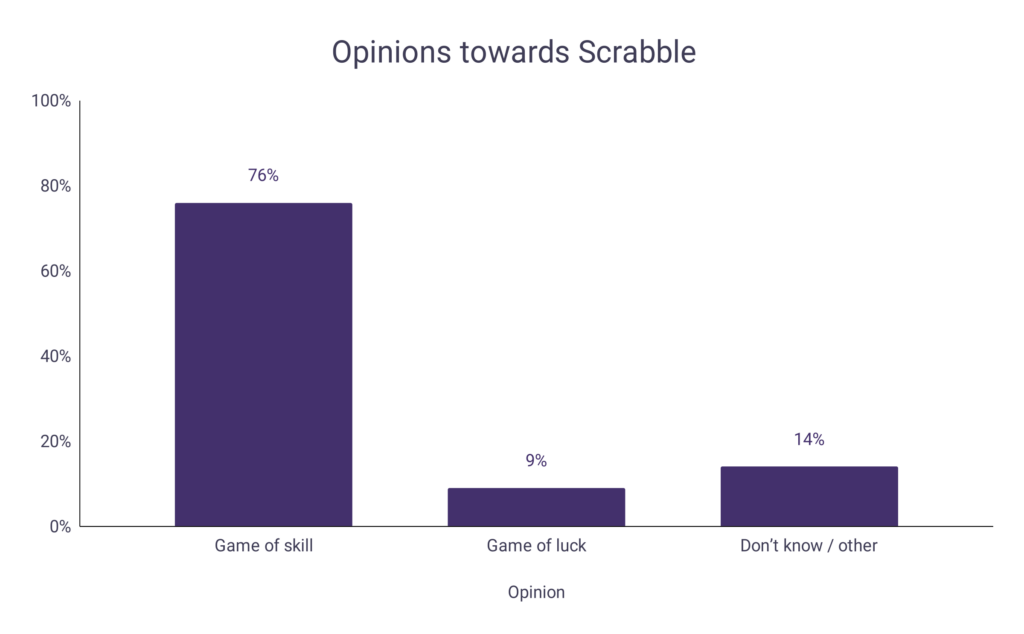
While luck does play a factor in Scrabble by determining the order in which players take their turns and the letters they draw, a lot of skill is also needed in the game. As a general rule, players who have a larger vocabulary should fare better at the game. People who are skilled at anagrams should also score well, as well as those who understand the best ways to maximize scores through the optimal usage of premium squares.
| Opinion | Percentage |
| Game of skill | 76% |
| Game of luck | 9% |
| Don’t know / Other | 14% |
A graph is given below to compare the opinions of Scrabble:
Benefits of playing Scrabble
Playing Scrabble with friends, family, or other players can provide a number of social and mental health benefits, even at the same time. In this article, WordRaiders looks at the benefits the game can bring players while they play and even in their personal lives.
- A 2024 survey found that 75% of UK adults enjoy or love playing word games such as Scrabble.
- In a separate 2011 survey, 18% of UK adults stated that Scrabble is their favorite board game (second only to Monopoly, which was the favorite game of 22%).
- One study found that people who play Scrabble competitively can identify real words vs. fake words 20% faster than those who don’t play the game.
- This is particularly noticeable when reading words vertically, which non-players are unlikely to practice often.
- Competitive players are also more likely to use a word’s visual appearance to determine whether it is a real word or not, in contrast to non-players who generally look to factor in a word’s meaning.
- Utilizing Scrabble as a learning tool can boost academic achievement in vocabulary, due to the focused mental stimulation it provides.
- A 2020 survey found that 76% of US adults believe Scrabble is a game of skill rather than luck.
- This suggests that all players can improve at Scrabble with regular practice, thereby maximizing the personal benefits they derive from the game.
Building vocabulary
The very nature of Scrabble is to analyze randomized letters on a rack, previously played words on the board, and evaluate the best word to play based upon this information. As one of the most popular word games of all time, it is no surprise that Scrabble can have a great positive effect on its players’ vocabulary.
Regular players of the game will be more familiar with the use of prefixes and suffixes, which are a vital part of the game in order to reuse previously played letters, alongside other word constructions. With time, players should start to notice an increase in the size of their vocabulary, and they may even gain a deeper knowledge of their definitions.
Promotes critical thinking
Although building lengthy words on each turn may at first seem like the best way to play the game, it is better to take a more strategic approach when playing Scrabble. Players should always analyze the state of the board and try to plan a few moves ahead, ensuring they can maximize their point score on each turn while minimizing that of their opponent.
Good habits from the game, such as analyzing, predicting, and balanced risk-taking, are also applicable to other areas of our lives. With regular practice, positive habits learned in Scrabble can influence us to make better life decisions.
Previous studies have shown that playing word games can enhance an individual’s cognitive capacity. This can be particularly beneficial for individuals who struggle to learn through traditional methods, such as verbal or written exercises.
What’s more, players of an inquisitive nature are more likely to take an interest in the finer details of words played due to their thirst for knowledge. This can help them gain a better grasp of the subject areas they may not have previously explored.
Control of emotions
Whether it is elation or anger, board games can bring out a wide range of emotions in players of all ages and backgrounds. As such, every time we play a round of our favorite board game, we have the opportunity to test our emotional control.
By stifling negative feelings that come from frustration and resisting the urge to play moves too quickly out of excitement, players can maintain a balanced approach in each game scenario, helping them make rational decisions. Regular players may find that they develop a calmer, more balanced outlook on a day-to-day basis, leading to an improved quality of life. However, these games can also bring out the worst in people and many players do cheat at Scrabble.
Builds confidence
As with any game or challenge we encounter, Scrabble can be a great way to improve a person’s overall confidence. Upon each turn, players have to try to work out the best possible move that will score them a high number of points and leave them in a good situation for upcoming moves.
This process of decision-making under pressure in front of other players requires self-confidence in one’s abilities. Confidence levels can increase as each player gets better at the game, which can later spread and help with relationships and in professional settings.
Improves concentration
People who struggle to remain focused on their daily tasks may find that Scrabble helps them to concentrate. Due to the game’s standard format, players need to spend a lot of time analyzing different letter combinations on their rack and board during their turn, as well as those of any other players.
Scrabble’s competitive element also adds a certain level of pressure, pushing players to focus on the task at hand to make the best moves they can. Repeatedly going through the process of focusing and forming words should eventually boost concentration, which can be beneficial in other areas.