
- Between 1950 and 2018, 95% of American fiction books published were written by white authors.
- Author diversity has since increased but white writers are still over-represented.
- Non-hispanic white authors wrote 89% of the books analyzed for the year of 2018.
- As of 2020, 75% of industry respondents claimed their book publishing employer had made efforts in the last year to increase diversity and equity.
- Just 50% of publishing employees where DEI initiatives had been introduced believed it would result in real change.
- As of 2021, Erroll McDonald (VP & Exec. Editor: Alfred A. Knopf) claimed more people of color were given senior publishing positions within the last year than in decades.
- However the entry-route to these positions was often to enter the industry from the outside.
- As of 2021, more than 52% of those in publishing executive leadership were women in the UK.
- This increased to 56% for senior management positions.
- UK ethnic minority group representation has increased to 15% (excluding white minorities).
Find out about listed black-owned publishing companies in the US and UK.
Diversity in US book publishing
- 95% of American fiction books published were written by white authors between 1950 and 2018.
- Despite increasing author diversity, white writers are still over-represented.
- For the year of 2018, non-hispanic white people wrote 89% of the books analyzed.
- As of 2020, 75% of respondents in the industry claimed that their employer had made efforts in the last year to increase diversity and equity.
- Despite these findings, around just 50% of employees where DEI initiatives had been introduced believed it would result in real change.
- Erroll McDonald (VP & Exec. Editor: Alfred A. Knopf) claimed in 2021 that more people of color were given senior publishing positions within the last year than in decades.
- A drawback however was that the entry-route for many was to enter from outside the industry.
- Tracy Sherrod (Editorial Director – Amistad) noted a “correlation between the number of people of color who work in publishing and the number of books that are published by authors of color”.
- As of 2020, more than 50% of the 10 most recent books to receive the National Book Award for Fiction were authored by people of color.
Racial diversity in US book publishing
- As of 2019, white/caucasian industry respondents represented 76%. This is a drop of 3% since 2015.
- 7% was made up by asian/native hawaiian/pacific islander/south asian/southeast indian respondents.
- 6% was made up by latinx/latino/mexican respondents.
- 5% was made up by black/afro american/afro caribbean respondents. This is a 1% increase since 2015.
- 3% was made up by biracial/multiracial respondents.
A chart to show racial diversity in US book publishing is given below:

Gender diversity in US book publishing
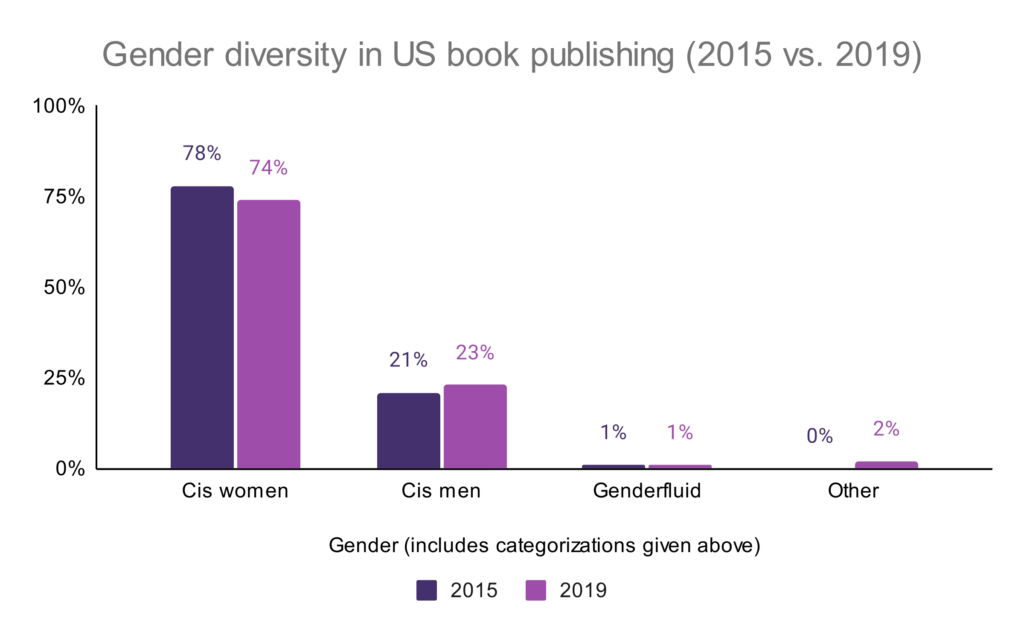
- As of 2019, 74% of respondents in the industry were cis women. This dropped 4% since 2015.
- 23% of respondents were cis men. This is an increase of 2% since 2015.
- Genderfluid/non-binary/genderqueer/non-conforming represented 1%.
A chart to show gender diversity in US book publishing is given below:
Orientation diversity in US book publishing
- As of 2019, 81% of industry respondents were straight/heterosexual. This has dropped 7% since 2015.
- 10% of respondents were bisexual/pansexual. This represents an increase of 6% since 2015.
- 6% of respondents were gay/lesbian. This has dropped by 1% since 2015.
- 1% of respondents were asexual.
A chart to show orientation diversity in US book publishing is given below:

US diversity in book publishing by disability
- As of 2019, 89% of industry respondents reported that they did not have a disability.
- In total, 11% of respondents did report having a disability.
- The number of respondents with a disability has increased by 3% since 2015.
- This increase in the number of respondents with a disability during the period could also be attributed to an increased recognition of disabilities caused by mental health issues.
WordsRated researches diversity in publishing and builds tools for everyone who loves language. Our Wordle Solver is updated every day for Wordle players, and we publish daily hints for today’s Connections and today’s Wordle. If you play Scrabble and want to check if a word is in the official dictionary, our Scrabble Dictionary has the answer.
Diversity in UK book publishing
- As of 2021, more than 52% of those in executive leadership in the industry are women.
- For senior management positions, this increased to 56%.
- Within the publishing industry, ethnic minority group representation has increased to 15% (excluding white minorities).
- 13% of industry respondents identified as lesbian, gay, bi or preferred to self-describe their sexual orientation.
- In 2017 this was just 5% but the figure has grown each year.
- Trans industry respondents represented 1%, in line with UK population statistics.
- People with a disability within the industry have increased to 13% in 2021, from 2% in 2017.
- There is an overrepresentation from privately educated individuals (19%) and those who hold a degree (83%), when compared to the UK population.
#PublishingPaidMe
- In 2020, a Twitter movement was created by US author L.L. McKinney to highlight pay disparities between Black and non-Black authors.
- Once viral, a Google document was created so that writers could crowdsource and share information about advances.
- Within a week, the document contained information for more than 2,500 books.
- This document showed that well-recognized black authors were earning small advances when compared to some unrecognized white authors.
- Jesmyn Ward is a black author who is also the first woman to win two National Book Awards for fiction.
- After winning her first in 2011, she tweeted that she had to heavily negotiate to receive a $100,000 advance.
- N.K. Jemisin, is a black author and the only person to win a Hugo Award three times in a row.
- For her trilogy “Broken Earth”, she received an advance of $25,000 for each volume.
- For “Great Cities”, her follow-up, she received an advance of $60,000 for each volume.
- Due to the movement, multiple white authors commented that they were shocked to find out that they received high advances when compared to black authors.