
Blending together different elements from some of the most popular word games, Strands is the latest addition to the NYT Games Section for you to try out! Providing fans of word games with a fresh new challenge, the goal of the game is to uncover words related to a given theme before the end of the day.
How to play Strands NYT
To play Strands, players will need to find a number of words hidden within a 6×8 grid containing 48 letters. Each solution word will be related to a theme that is provided to the player at the start of the game, while the total number of words found will also be listed.
As Strands is a daily game like Wordle, a new grid of letters, a new theme and solution words will be released every 24 hours. Players must find all of today’s Strands answers within the grid to win the game. The letters themselves will stay in the same position throughout the duration of the puzzle.
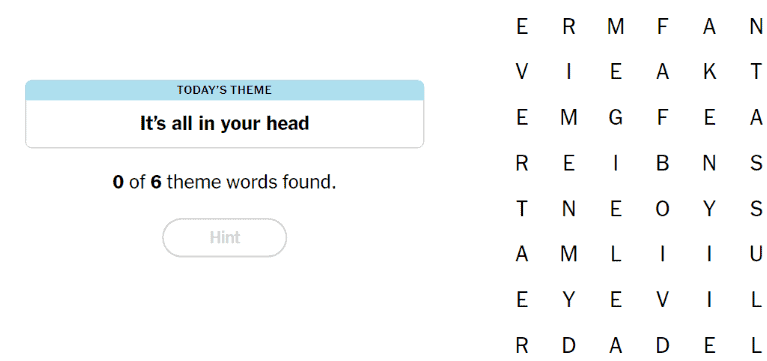
To solve words, letters can be joined together horizontally, vertically or diagonally by one space to its immediate side. Players can combine as many unselected letters together as needed but only dictionary words of more than 3 letters will be accepted as answers.
Selecting letters can be done by clicking on each letter in sequence or alternatively by clicking and dragging over the intended letters. Players may opt to enter themed or non-themed words at any point during the game.
Once an accepted non-theme word has been found, its letters will revert to normal (unhighlighted) and the hint bar will increase by a third. Each time 3 non-theme words are found, the player will earn a hint. Players can enter as many non-theme words as needed but they must use the hint button before they can begin earning additional hints.
After earning the possibility to gain a hint, the player can click on the hint button to reveal the letters of a themed word which will be circled. However, the player will still have to solve an anagram from the circled letters to find the themed words. All of the letters circled will be present in the anagram, so it is just a case of getting them in the correct letter order.
Once solved, the dotted circles around each letter of the hint will be filled with the color blue to reveal the themed word. Themed words will eventually cover every letter on the grid without any words overlapping each other at the end of the game.
The most important and often the hardest term in the game is called the spangram, which describes the puzzle’s theme in more detail. In addition, it will touch two opposite sides of the board (top and bottom or left and right) and may even be made up of two separate words. An example of a spangram could be the word METAL, when surrounded by theme words such as ROBOT, ARMOR and SCREWS.
Note: As the spangram is the difficult term to find, it will always be the last hint revealed to the player.

When the level has been completed, every letter will be colored blue or yellow and a results screen will appear to show how you performed. On the results page, a lightbulb is displayed for each hint used, blue circles indicate when themed words were found and a yellow circle is used to indicate when the spangram was found. The order of the guesses goes from left to right on the top row and continues in the same fashion in the next row(s).
To beat Strands, it doesn’t matter how many non-themed words are guessed or how many hints are used. Despite this, experienced players may look to complete the game using no hints (which will display a “Perfect!” message) or in as few hints as possible to give themselves a greater challenge.
What’s more, a button for results sharing is provided at the end of that game so that each player can show and compare their game overview to other players. This can add a more competitive element for those who want more than to solely defeat the day’s puzzle.
NYT Strands tricks and strategy
Whether you are entirely new to Strands or have played through various levels, it can be of great benefit to look at the game’s best practices. To help you out, WordRaiders has put together some key strategies for you to think about and implement.
Start with the corners
If you like to approach the game statistically, it’s obvious that the corners on the board have the lowest entropy – letters in the corner have the fewest surrounding letters.
If you look at the letter in the very corner, each of them is connected with 3 surrounding letters. You move from the corners around the edges, and each letter on the edge of the board can be connected with 5 surrounding letters, while any letter away from the board edges is surrounded by 8 different letters.
This can give you a good hint on where to start looking for words:
- Look at the corners first
- Then move around the edges of the board
- At the end, move towards the middle
Starting with corners and edges is also beneficial for anyone looking to find spangrams first, since spangrams start and end on the opposing edges of the board.
Look for common extensions
With so many unique words in the English language, it might help to start with ones that share some commonalities. For example, there are some widely used prefixes and suffixes, such as DE-, EN-/EM-, MIS-, NON-, PRE-, -ED, -ER, -ING, -Y, and others.
Identifying these groups of letters will likely lead you to one of the answers, or even to spangram.
Identify less frequent letters
If you’ve played Scrabble, you know that letters like Q, Z, X, and J are the highest-scoring letters in the game. This is not without a reason – these letters are not easy to find in the dictionary.
You should use this knowledge to identify these letters on the board and start looking for words around them. The chances are you’ll quickly figure it out, especially since you know what the theme is.
If it’s a word, but not accepted, it’s probably spangram
At some point, you’ll find a word on the board that seems related to the theme hint. When that happens, and it turns out that the word is not an answer, don’t give up on it – it might be a part of a spangram.
For example, if you played Strands on January 24th, 2025, you might’ve found the word PAINTING. And since the theme hint is “A work of art”, you’re convinced that’s one of the answers. But after submitting it, it turns out it’s “just” a hint.
Don’t give up – it’s probably a spangram. In this particular case, the spangram was “FAMOUS PAINTING”. So remember to keep looking when this happens, you’re probably on a good path to find spangram.
Look between solved letters
After identifying 2 or more themed words on the grid, you may sometimes find a stream of unidentified letters that pass in-between that can only be connected in one way. If you encounter this situation on the grid, you may be able to identify another themed word.
The trick will be to work out which of the given letters will start or end the solution. This can usually be quite straightforward as word endings are often identifiable, helping you figure out the rest of the word.
Don’t be too proud to use hints
Players of Strands should always remember that they will earn a third of a hint for each non-themed word of 4 letters or more they can find. This means that finding three will allow the player to click on the hint button and reveal the letters to one of the themed words.
Once the hint bar is filled, any additional non-themed words you find will not contribute further to the bar. Due to this, it is good practice to reveal hints as soon as it is available to do so.
Remember the theme
Although it can always be tempting to dive straight in and find words, try to consider the theme of the day. Contemplate the theme given and see if you can think of some words to look out for on the grid.
The main benefits of finding themed terms early on in the game is that you will be one step closer to completing the game and you will also reduce the number of playable letters. Each time this happens, it should be easier to find the remaining answers.
Moreover, themed terms are likely to be longer in length than non-themed terms as they will eventually fill all 48 squares on the grid. As a result of this, finding words of a longer length is likely to increase your chances of finding a solution.
Take your time
As Strands is a daily game, it is important to recognize that players have a large amount of time to identify the themed words. Knowing this, many players like to use their downtime before or after work to have a go at solving a new level.
For those who like to play at various points throughout the day, Strands will remember your current game progress upon each login. This means you can come back to the game as much as you like, which will give your mind some time to contemplate possible solutions in the background as you switch to other tasks.
You can see yesterday’s Strands hint, all past Strands answers and NYT Strands statistics here.