

There are numerous benefits of reading – from helping with your focus and memory to developing empathy and communication skills.
In order to understand how fast can people read, we summarized findings from 21 scientific papers and articles, compiling 36 reading speed statistics and facts.
Average reading speed statistics
Reading speed is the number of words a person can read correctly per unit of time. It’s usually described in words per minute (wpm).
The average reading speed varies depending on different sources but is usually in the 200-300 wpm range:
- The average silent reading speed for an adult person is 238 wpm for non-fiction, according to a meta-analysis of 190 studies on reading speed.
- The average reading speed for fiction is 260 wpm.
- The average oral reading speed is 183 wpm, according to the meta-analysis of 77 studies with 5,965 participants.
- The average reading speed for learning is 100-200 wpm.
- The reading speed for memorizing the material is lower than 100 wpm.
Average reading speed by page
- For the typical paperback format, the average reading speed is 1 page per minute (60 pages per hour) for the adult person.
- The average college student can read approximately 20 pages per hour of easy fiction and non-technical material (the average textbook contains 800 words per page).
- For technical material, the average student can read around 11 pages per hour (149 wpm).
- The average reading rate for advanced scientific or technical is 6 pages per hour, which equates to 75 words per minute.
Reading speed and vocabulary size are closely linked and word games are one of the most enjoyable ways to build both. WordsRated’s Wordle Solver is updated daily for Wordle, and we publish hints for today’s Connections and today’s Wordle every morning. For a spelling-focused daily challenge, our Spelling Bee answers are published every day.
How fast can people read?
There are physical and technical limitations to how fast can a person read. Based on the methods they employ, there are 3 main types of readers – motor readers, auditory readers, and visual readers:
- Motor readers are limited to an average of 200-250 wpm. This is because they utilize subvocalization (sounding out each read word), which significantly limits a person’s ability to read faster.
- Auditory readers can read at a rate of 400-450 wpm. They don’t need to engage their lips or tongue while reading but rather can hear and say the words silently.
- Visual readers can read at rates over 450 wpm, and usually can read at a 700 wpm rate and higher. They don’t need to hear or say the word they’re reading.
- Around 20% of people who try to learn speed reading will never get over the auditory reading level.
- Some research claim that reading over 500 wpm with full comprehension is impossible due to the physical limitations of processing information by human eyes.
Some people claim to be able to read at a much higher rate with full comprehension:
- Annie Jones is a 6-time Worlds speed reading champion, able to read 4,700 wpm with 67% comprehension.
- Howard Berg set the Guinness World Record in speed reading 1990, allegedly reading 25,000 words per minute (or 80 pages per minute) with 100% comprehension. However, Guinness doesn’t no longer recognize any speed-read records.
- Maria Teresa Calderon claims to have the ability to read 80,000 wpm with 100% comprehension. This claim has never been officially confirmed.
- Bill Gates is reported to read 150 pages per hour or ~625 wpm with 90% comprehension.
Average reading speed by age
We analyzed the current literature regarding reading speed and broke it down into the following 30+ statistics on the average reading speed by age and grade level.
Average silent reading speed (1st through 12th grade)
Reading rate progress with each grade. The progress is fast through age 7-12, then slows down during teenage years (13 to 19).
The data is visually presented in the chart below:
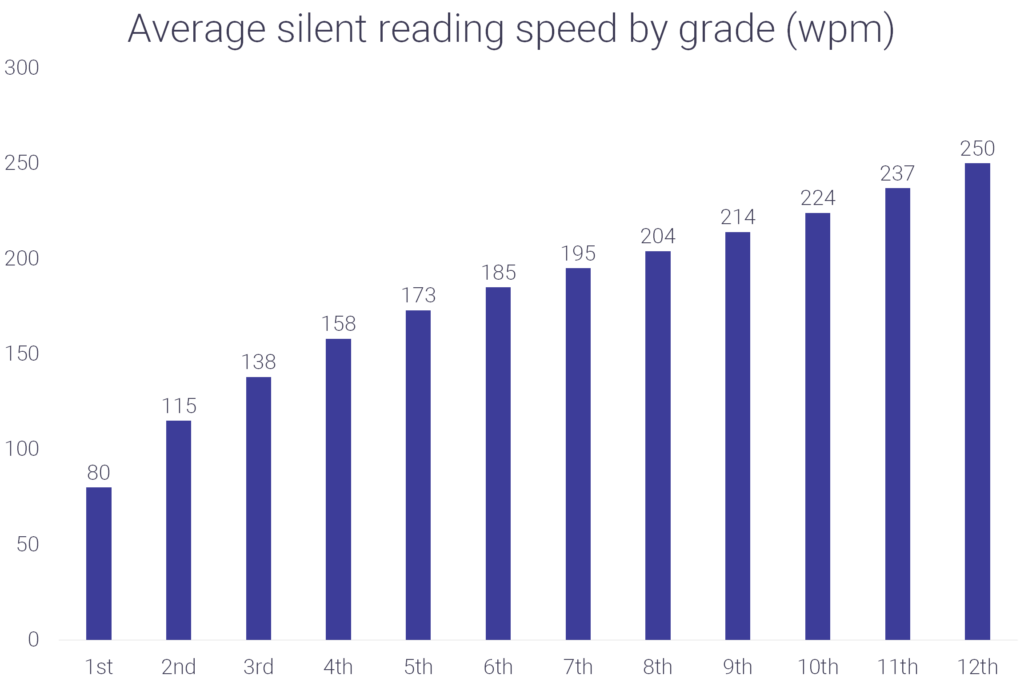
As mentioned, progress in reading speed is fast until the age of 13, when it settles at around 5% during the teenage years:
| Grade | Age | Average reading speed (wpm) | Yearly progress (wpm) | Yearly progress (%) |
| 1st | 6-7 | 80 | ||
| 2nd | 7-8 | 115 | +35 | 44% |
| 3rd | 8-9 | 138 | +23 | 20% |
| 4th | 9-10 | 158 | +20 | 14% |
| 5th | 10-11 | 173 | +15 | 9% |
| 6th | 11-12 | 185 | +12 | 7% |
| 7th | 12-13 | 195 | +10 | 5% |
| 8th | 13-14 | 204 | +9 | 5% |
| 9th | 14-15 | 214 | +10 | 5% |
| 10th | 15-16 | 224 | +10 | 5% |
| 11th | 16-17 | 237 | +13 | 6% |
| 12th | 17-18 | 250 | +13 | 5% |
Some studies discovered differences in reading rates between boys and girls. In general, girls read at a faster speed compared to boys:
- Female students (9 years old) read at a 2.3% higher rate than male 9-year-olds.
- 13-year old females have a 3.9% higher reading rate than males.
- 17-year old female students read at a 5% higher rate than male students.
Average oral reading speed (1st to 8th grade)
The oral reading rate is lower than silent reading, but it follows the same pattern of progress. It’s expressed as the number of correctly read words per minute (wcpm):
Here is a visual breakdown of the data presented above:
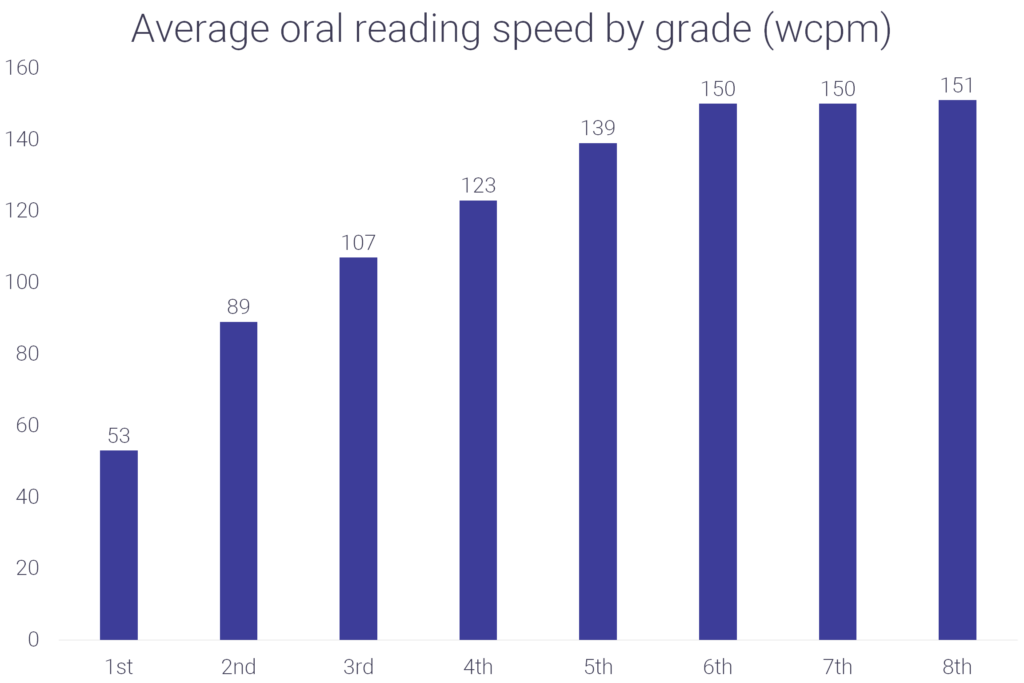
After a 68% increase in reading rate between 1st and 2nd grade, oral reading speed progress settles down and finally plateaus after age 13:
| Grade | Oral reading speed (wcpm) | Yearly progress (wcpm) | Yearly progress (%) |
| 1st | 53 | ||
| 2nd | 89 | +36 | 68% |
| 3rd | 107 | +18 | 20% |
| 4th | 123 | +16 | 15% |
| 5th | 139 | +16 | 13% |
| 6th | 150 | +11 | 8% |
| 7th | 150 | 0 | 0% |
| 8th | 151 | +1 | 1% |
Average reading speed in college
Reading speed plateaus during teenage and college years, reaching ~250 wpm. Depending on the skill level (remedial to above-average), here are average reading rates for college students:
Average college student reads:
- 250 words per minute of non-technical material.
- This equates to reading 19 pages per hour*.
- 140 wpm of scientific material, or 11 pages per hour.
Remedial student reading speed is:
- 150 wpm of non-technical material, or 11 pages per hour
- 100 wpm of scientific material, or 8 pages per hour.
For above-average college students, the average reading speed is:
- 500 wpm of non-technical material.
- This equates to reading 38 pages per hour.
- 170 wpm for scientific material, or 13 pages per hour.
*average textbook page = 800 words
Average reading speed for adults and older adults
After a progressive increase in reading speed during pre-teenage years, the reading rate stabilizes at ~250 wpm rate during teenage years and college. Some studies suggest that reading speed increases during college years up to 300-350 words per minute.
As people get older, reading speed starts to decrease. Studies that compared reading rates of different generations established this progression line:
- Reading speed significantly increased from children to teenagers
- It stabilized from teenagers to young adults
- Reading rate was significantly reduced from young adults to adults
Another study points out changes in reading speed for different age categories:
- The increase from 8 to 16 years (140–200 words per minute)
- Stabilization in the range of 16 to 40 years (200 ± 25 wpm)
- Decrease to 175 words per minute by 81 years of age.
Liu (2017) compared the average and maximum reading speed of young adults (age 18-31, mean age 22.6) with older adults (50-73 years old, mean age 58.2), and established that:
- Older adults showed a 30% decrease in reading speed compared to young adults.
What impacts reading speed?
Aside from age, there are several other factors that can affect reading speed. They span from the way letters and words are positioned and designed to differences among languages and coping with certain health conditions.
The visual span of reading, defined as the number of letters in a text that the reader can recognize without moving his/her eyes, has a significant effect on reading speed:
- A study has shown that there is a strong correlation between visual span size and reading speed (between 53.1% and 93.9% of the variance in reading speed).
- Another study points out that the expansion of visual span by 6 bits can lead to a 41% increase in maximum reading speed.
The effect of letter spacing on reading speed is similar to the effect of age. According to D. Yu (2007):
- Reading speed increases with increased letter spacing, reaching maximum at standard letter spacing.
- At spacing 2x the size of standard, reading speed decreases by 25%.
Crowding, the (in)ability to recognize distinct objects (letters) in a clutter, also affects reading speed. As crowding increases with age, studies showed that it can lead to reduced reading rate:
- Older adults (mean 58 years old) exhibit a 31% increase in crowding zone compared to younger adults (mean 23 years old).
- At the same time, the same group exhibited a 30% reduction in reading speed.
Some studies show that reading sources can have a significant effect on reading speed:
- Reading on paper makes reading 10%-30% faster compared to reading on screen.
- Several studies also show that reading comprehension is higher on printed media compared to digital.
Language impacts reading speed. One of the studies analyzed reading speed in 12 different languages, and the rate varied from 181 wpm for Arabic to 285 wpm for the Italian language.
Various health conditions could affect reading speed. Among them, the most common are dyslexia, alexia, hyperlexia, vision-related problems, trauma. Reading speed can also be a problem for people who have problems with word decoding, fluency, and reading comprehension.
Speed Reading
The average adult reading speed stands at 239 wpm. However, we’ll often encounter various speed reading programs and apps that unlock reading rates over 700 or even above 1,000 wpm.
We researched the available literature on rapid reading methods to investigate the effectiveness, benefits, and drawbacks that speed readers can encounter. We’re presenting you X stats and facts on speed reading.
Reading speed levels
To achieve rapid improvements in reading speed, readers must overcome subvocalization, which limits reading rate to ~400 words per minute (wpm):
- The average reader, reading around 250 wpm, is a motor reader. They engage either lips or tongue while going through every word, which has a negative impact on the reading rate.
- If a reader manages to suppress the use of the tongue or lips, he gets into the auditory reading zone. Auditory readers can achieve reading speeds up to 400-450 wpm.
- Readers able to completely overcome subvocalization are visual readers. This is a speed reading territory, as visual readers can read at rates over 500 wpm, or even over 1,000 wpm.
Speed reading records
Most of the population remains at the normal reading rate (200-350 wpm). But some people’s reported reading skills to go way beyond the average human’s capabilities:
- Annie Jones is a 6-time Worlds speed reading champion, able to read 4,700 wpm with 67% comprehension.
- Howard Berg set the Guinness World Record in speed reading 1990, allegedly reading 25,000 words per minute (or 80 pages per minute) with 100% comprehension. However, Guinness doesn’t no longer recognize any speed reading records.
- Maria Teresa Calderon claims to have the ability to read 80,000 wpm with 100% comprehension. This claim has never been officially confirmed.
- Bill Gates is reported to read 150 pages per hour or ~625 wpm with 90% comprehension.
- John F. Kennedy, according to reports, was able to read 1,500 wpm.
- Another former president of the USA, Jimmy Carter, allegedly could read at 2,000 wpm with 95% comprehension.
- Evelyn Wood, an American teacher who popularized speed reading, said she could read 2,700 words per minute.
Common speed reading techniques
There are several methods to improve current reading speed and become a speed reader. Most of the speed reading apps and programs are based on these few basic techniques.
Skimming & scanning
Skimming is a type of speed reading where readers visually search for indicators of the main idea of the text in question.
- This method can be useful for readers to get a quick overview of the general idea of the text in a limited time.
- However, skimming is not effective when detailed information from the text is needed, as it reduces the comprehension levels (more details in sections below).
Scanning is the process that naturally follows skimming. Essentially, through scanning, readers create a visual hierarchy of information extracted through skimming.
Meta guiding
Meta guiding is a speedreading method that helps the reader move his eyes faster through the text. This is usually accomplished by using some kind of pointer to follow the set path of the eye through the lines.
The main goal of guiding is to reduce regressions, which occur during the normal reading experience. Some claims state that meta guiding also reduces subvocalization.
- Because of the claimed reductions in regression and subvocalization, the meta guiding technique can significantly reduce reading time.
- On the other hand, because it contains skimming elements, meta guiding can have a negative impact on comprehension rate.
Rapid Serial Visual Presentation (RSVP)
RSVP presents a method used in most speed reading apps. The principle of this method is to limit the eye fixation to one place, instead of forcing the eye to move across the lines and paragraphs. This is accomplished by presenting the words, one by one, at the same location but at different time intervals.
- By minimizing the saccades and regressions, readers are able to get over the 400 wpm rate.
- The inability to regress and go through the text multiple times negatively affects the understanding of the text, according to comprehension tests from multiple research papers.
Pros of speed reading
We dived into academic research papers to find the benefits of various methods of speed reading. It’s worth noting that different people have different reading goals and thus might benefit from fast reading in different ways.
In general, these are cases where speed reading can be beneficial to various groups of people. Speed reading techniques can improve both the reading and comprehension rates of slow readers.
Benefits of speed reading for students
Several research papers showed that taking a speed-reading class can be beneficial for students learning and comprehension rate:
- One group of students that employed skimming and scanning was able to increase comprehension rate by 16.5% while also becoming faster readers in the process, going from 204.29 wpm to 274.07 wpm (34.1% increase)
- The same group was also able to absorb more information about the microstructure of the text compared to the group reading at the normal speed.
- Another study showed that compared to the control group of students, who didn’t enroll in speed reading class, the group that did was able to significantly increase the comprehension levels by 13.9%.
Benefits of speed reading for adults
- The group of adults enrolled in a speed-reading class was able to increase the reading speed by 42.8% while suffering a small loss of comprehension (around 9.5), according to one study.
- Speed reading courses enable learners to increase their reading rate in a short time. One research estimated that a 12-week course is sufficient for significant improvement in reading speed.
- The same research showed that this increased rate is transferable to other types of tests, as the group that enrolled in the course kept outperforming the control group regardless of the type of text.
- Most of the participants were also able to maintain a 70% comprehension score, even with a reading speed increase.
Benefits of speed reading for non-native English speakers
People who are learning the English language can ramp up the process by taking the speed reading course. This is possible mostly due to low starting reading rates:
- A study in Venezuela showed that students of an English course increased their reading speed by 41.6% (from 120 to 170 wpm).
- This improvement didn’t affect comprehension significantly, dropping from 78% to 67%.
- Another study on English course participants, who took speedreading training, showed an increase in reading rate by 85%, while also increasing comprehension levels by 19%.
Cons of speed reading
While taking a speed reading course could be beneficial for people with lower reading rates, or people who are starting to learn the English language, reading at an extremely high rate doesn’t come with consequences.
Becoming a faster reader doesn’t necessarily mean becoming a skilled reader. Speed reading comes with some consequences that need to be addressed.
Some experts explain that there are certain limitations of the human mind that severely affect comprehension as readers go over 400 wpm:
- Keith Reiner, an expert in the field of eye-tracking, stated that going over 500 wpm doesn’t come with severe comprehension loss.
- Our comprehension capacity is limited by anatomy and eye movement. By skipping the words through speed reading we’re unable to process all the information.
- Due to anatomy limitations, there’s a certain rate at which our brain can process visual information. Pushing over that rate significantly affects comprehension.
Taking a speedreading course while reading at lower rates than average reading speed has a positive effect on comprehension.
However, once the reader leaves the subvocalization zone and enters the speed reading area, numerous studies show that it comes with a price – a significant decrease in comprehension:
- By employing the skimming technique, readers are unable to develop a deeper understanding of the text.
- When skimming, readers must make a compromise between finding the most important aspects of the text and getting a detailed insight.
- One study showed that, when employing the RSVP method, participants’ comprehension levels dropped by 50% with the increased reading rate.
- Another research compared speed readers (600-700 wpm), skimmers, and normal readers (~250 wpm). The results showed that normal readers outperformed both speed readers and skimmers in comprehension tests.
- Research into the RSVP method showed that, when participants read 7th- to 8th-grade material at a 705 wpm, they had a 70% comprehension accuracy score, while more difficult material, 9th- to 10th-grade level, reduced comprehension to 55%.
Benefits of slow reading
While speed reading could be utilized for certain reading goals, going the opposite direction also has its benefits:
- Poulton (1958) discovered that the amount of content that the reader retains increases significantly when the reading speed goes from 300 wpm to 150 wpm.
- Researches revealed that the amount of stress could be reduced by 68% among people who were reading slowly and silently for 6 minutes.
- Also, 30 minutes of slow reading will have a positive effect on anxiety.
- One research claims that reading out loud can slow down the progress of Alzheimer’s disease and dementia.
- Studies also showed that people who read at the college level (250-300 wpm) or above tend to read slower when they read for pleasure.
- When there’s a need for a deep understanding of the text, it’s not enough to focus only on the most important elements but also on details that provide context. This leads to slower reading speed, but much greater comprehension.
FAQ
How do you measure reading speed?
Measuring reading speed can be accomplished by several methods. The most simple method would be reading a random page (medium-level reading) material for 1 minute and counting how many words have been read.
Another method would be estimating the number of words on a page (by counting the number of words in the first 2 lines and finding the average), then counting the number of lines on a page and multiplying it with the average number of words per line.
This would give an estimate of the number of words on a page. After that, read the whole page of the material, measuring the time needed for completion. Finally, divide the number of words on a page by the number of seconds it took to read them and multiply it by 60. This will give you your wpm rate.
How does reading speed impacts comprehension?
Studies have shown that, for the average human, reading at rates over 500 wpm isn’t possible for 100% comprehension. One of the possible reasons for this is the fact that the very things that slow down our reading are the things that make us understand what we’re reading.
This includes subvocalization and regression, a process where we glance back at the words we’ve previously read. By eliminating these 2, we’re able to read at rates over 400 wpm, but as a consequence, we sacrifice comprehension.
For reference, the usual reading speed for memorizing is under 100 wpm, while the average rate for learning is between 100 and 200 wpm.