

- In a survey, 65.30% of US adults find the most valuable thing about board games is that they give them the ability to have fun.
- Having fun while playing board games encourages players to relax, smile and laugh, boosting serotonin and decreasing anxiety.
- However, 50.60% feel that the biggest benefit of board games is that they give more opportunities to socialize.
- The risk of developing Alzheimer’s has been seen to reduce by 47% in regular board game players and puzzle solvers.
- In addition, the risk of suffering from dementia was found to be 15% lower in board game players vs. non-board game players over a period of 20 years.
- Multiple skills can be learned through board games that have practical usage beyond the game, such as the effects of good and bad decision-making, patience, critical thinking and willpower.
- Developing from a beginner into a seasoned board game player can increase the gray matter volume in the brain, increasing cognitive function and improving the ability to make decisions.
- When used as a learning tool, board games can make it easier for learners to concentrate and participate.
- Students that struggle in a traditional classroom environment have been found to be more receptive to learning using board games.
- Whereas video games tend to have less social engagement, board games encourage conversations and give players an increased sense of companionship.
Key benefits of board games
Board games can provide a range of benefits to an individual’s social life and mental health. What’s more, many people will experience multiple benefits at the same time from a round of their favorite board game with friends and/or family. Considering these, it is no surprise that people have enjoyed partaking in the timeless pastime for thousands of years.
| Key benefit | Percentage* |
| Increase in confidence | 29.60% |
| Better social life | 36.80% |
| Better mental health | 40.80% |
| Reduces stress | 47.80% |
| More opportunities to socialize | 50.60% |
A graph is given below to show the benefits associated with board games:

If you are a board game lover who would like to get better at word games such as Scrabble, check out the WordsRated Word Finder. Simply enter the letters available to you on the rack plus any potential combination letters from the board and hit “search” to find a list of playable words. You can even specify word length to find those high scoring 7-letter words!
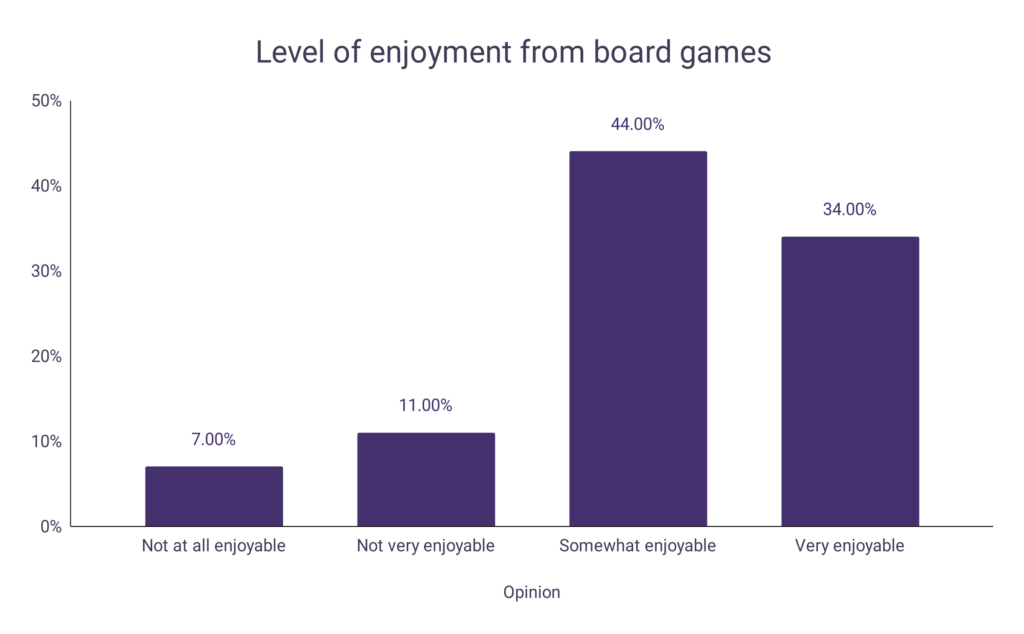
Level of enjoyment from board games
The majority of board game players (78.00%) find it to be at least a partly enjoyable way to spend free time. Even though there are people that find it hard to enjoy board games, they are in a significant minority. Just 7% of people do not find board games to be enjoyable at all.
| Opinion | Percentage* |
| Not at all enjoyable | 7.00% |
| Not very enjoyable | 11.00% |
| Somewhat enjoyable | 44.00% |
| Very enjoyable | 34.00% |
A graph is given below to show the level of enjoyment from board games:
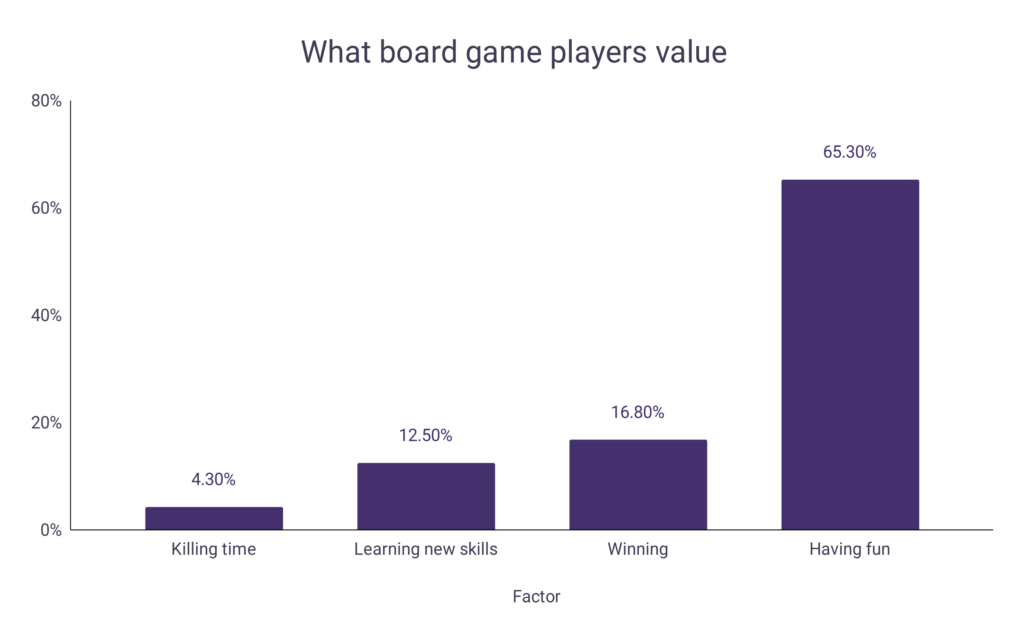
What board game players value
Overwhelmingly, players tend to enjoy board games as a way to have fun in their free time. The multiplayer aspect of many games could be a huge contributor to this, as players can enjoy the game together, socializing and enjoying the moment. This can be reflected by the comparative lack of one-player board games, as they are a much more solitary and less stimulating activity.
| Factor | Percentage* |
| Killing time | 4.30% |
| Learning new skills | 12.50% |
| Winning | 16.80% |
| Having fun | 65.30% |
A graph is given below to show what board game players value:
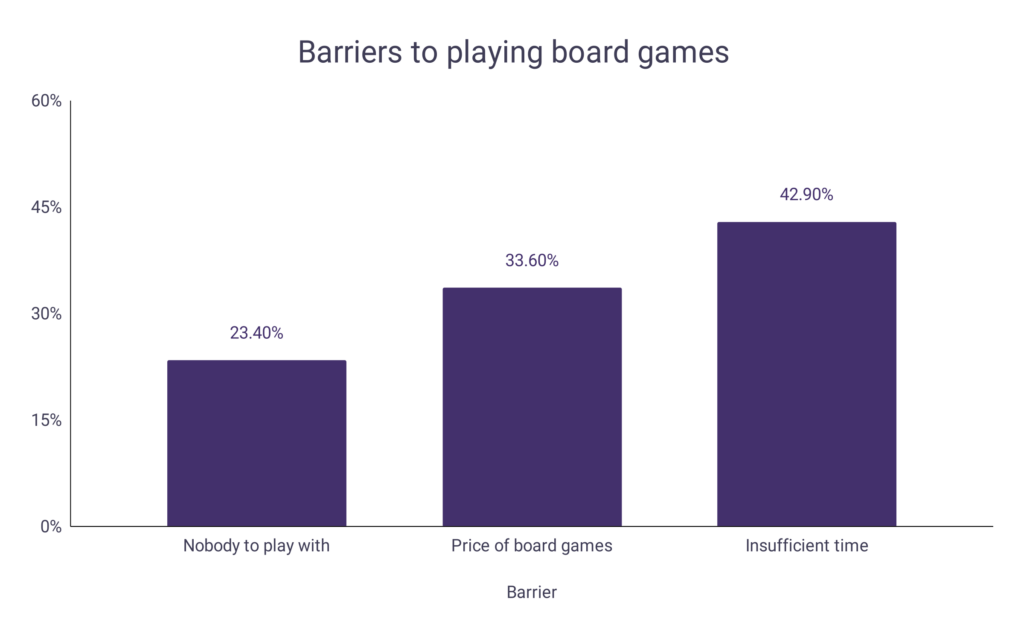
Barriers to playing board games
Even though playing board games comes with a whole host of benefits, there are some major barriers that prevent people from playing them. Interestingly, the biggest barriers listed are not related to a lack of enjoyment and are instead linked to their practicality and market pricing.
| Reason | Percentage* |
| Nobody to play with | 23.40% |
| Price of board games | 33.60% |
| Insufficient time | 42.90% |
A graph is given below to show the barriers to playing board games:
Benefits of different board games
Most board games are categorized by age, so that the players can get the best possible experience from each game. The most popular and well-designed board games often encourage players to communicate, collaborate and engage in balanced risk taking to win.
- After 4.5 months of studying chess, second-graders in Venezuela were shown to dramatically increase their IQ scores.
- Scrabble players have been found to recognize English words against nonsense words 20% faster than those who don’t play the game.
- Monopoly can be used to teach people the principles of math, such as counting, addition/subtraction, multiplying and percentages in addition to the financial concepts of taxes, rent and mortgages.
- Number-based board games can help children in particular improve their math ability.
- The facts referenced through games such as Trivial Pursuit can exercise the mind, testing memory recall and aiding retention.
- Although some debate exists over whether or not they should be considered board games, Jenga can improve dexterity and hand-eye coordination, while Twister can even increase physical coordination and balance.