

The book publishing industry has increasingly needed to evolve in order to remain influential as a source of entertainment and education. New sources of media such as on-demand video, streaming audio services and videogames can all be seen as competitors to publishers in the battle to capture consumer attention.
Since the breakthrough emergence of Amazon in the publishing space, the industry as a whole has been greatly affected by its growth and dominance. While the e-commerce company has heaped pressure on traditional publishing houses by setting new benchmarks, its business model has helped launch the careers of millions of self-published authors.
Impact of technology on publishing
Technology shapes the modern world and contributes to the development of all industries. Within publishing, the development of electronic book formats and the rise of social media have changed the focus of the industry as a whole.
- The global ebook market is estimated to be valued at $32.19 billion by 2032.
- As of 2023 ebooks represent 56% of all e-publishing income.
- Audiobook downloads have grown in popularity by 2.7% since 2020 (US consumer trade book sales).
- Globally, audiobooks are the fastest-growing book publishing format.
- Sales of books in physical stores represent less than 20% of sales.
- Despite advances in technology, 9 out of 10 young people still prefer to read physical books compared to digital versions.
- Almost 10% of reading around the world is performed on digital devices, a number that is constantly growing.
- Due to technology developments, 70% of Australian authors across all genres have changed the way their work is published.
- New technologies such as social media platforms impact the way that 2/3 of Australian authors interact with their readers.
- More than 50% of Australian authors believe that modern technologies provide new possibilities to publish original paid work.
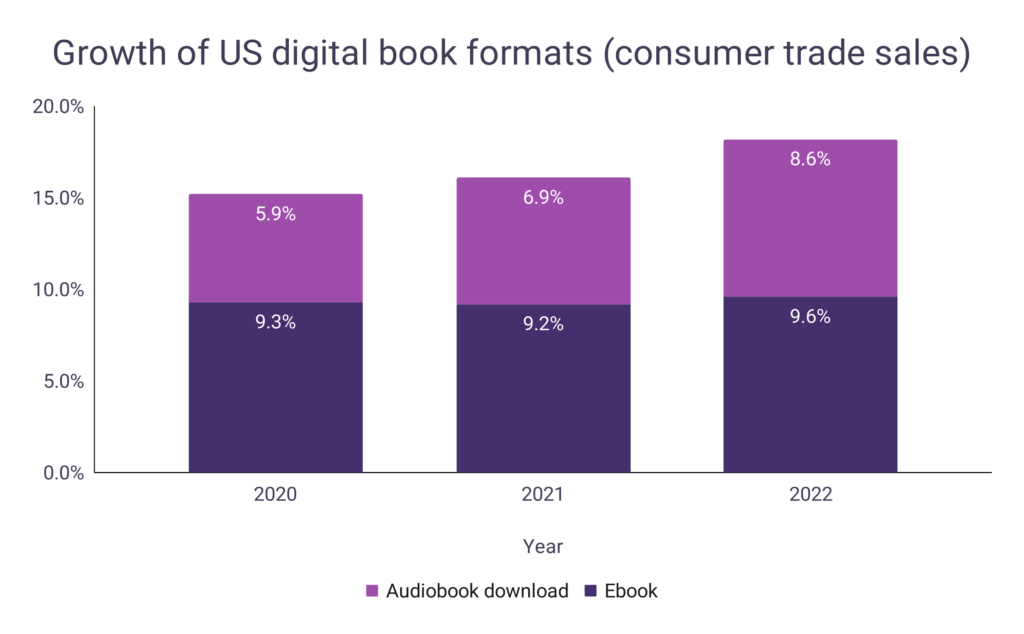
Growth of US digital book formats (consumer trade sales)
Although ebook sales were very stable during the years affected by the pandemic, audiobook sales have continued to increase. Both of these digital formats are predicted to increase in growth as more consumers become accustomed to new technologies.
- Ebooks grew from 9.3% in 2020 to 9.6% in 2022.
- Although ebooks were mostly stable over the period, the format is anticipated to grow.
- Audiobook downloads grew from 5.9% in 2020 to 8.6% in 2022.
- In total, audiobooks increased by 2.7% over the period.
- When combined, ebook and audiobook downloads increased by 3% over the period.
| Year | Ebook | Audiobook download |
| 2022 | 9.6% | 8.6% |
| 2021 | 9.2% | 6.9% |
| 2020 | 9.3% | 5.9% |
A graph is given below to show the growth of US digital book formats:
Impact of technology on different publishing formats
Publishing companies must now focus on producing, marketing and selling both digital versions of their titles alongside physical versions. Consumers have rapidly adopted new technologies such as smartphones, e-readers and tablets which together have led to new demands for the industry.
Physical books
- Sales of books in physical stores represent less than 20% of sales overall.
- For the US, Amazon’s print book market share exceeds 40%.
- In total, Amazon sells over 300 million print books annually in the country.
- 9 out of 10 young people prefer to read physical books compared to digital versions.
- Alongside their simplicity, physical books offer young people the opportunity to reduce their overall screen time.
Ebooks
- Globally, the ebook market is anticipated to be worth $32.19 billion by 2032, at an annual growth rate of 4.9% (compound).
- 75% of all ebook sales in the US are purchased through Amazon.
- 2012 was the first year that Amazon began selling more ebooks than physical books.
- From 2010 to 2020, the number of ebooks sold per year almost tripled, from 69 million to 191 million.
- Many classic books have been converted into ebooks, which makes them more appealing to young readers in particular.
- Typically, ebooks also cost less to produce than physical books, which is better for publishing companies.
Audiobooks
- By 2030, revenue from audiobooks is expected to reach $35.05 billion.
- This represents a growth of 26.4% each year from 2022 to 2030.
- Audiobooks are the fastest-growing book format globally.
- This applies in terms of revenue, sales growth and production volume.
- In general, an audiobook can cost more to produce than physical books but their reproduction comes without costs.
Impact of technology on educational publishing
- The digital education publishing global market is expected to grow annually by 17% until 2027.
- This is a rise from $15.74 billion in 2023 to $29.5 billion in 2027.
- 74% of teachers agree that educational technology (including e-publications) motivates students.
- Furthermore, it has been found that e-learning is more effective than traditional classroom learning by 11%.
- However by removing price as a factor, 75% of students still prefer physical textbooks over digital textbooks.
Impact of social media technologies on publishing
Social media has had a significant impact on many industries and publishing is no exception. Technology platforms such as Goodreads, Instagram, TikTok, Twitter and YouTube have completely changed the way the publishing industry communicates and sells to its audience.
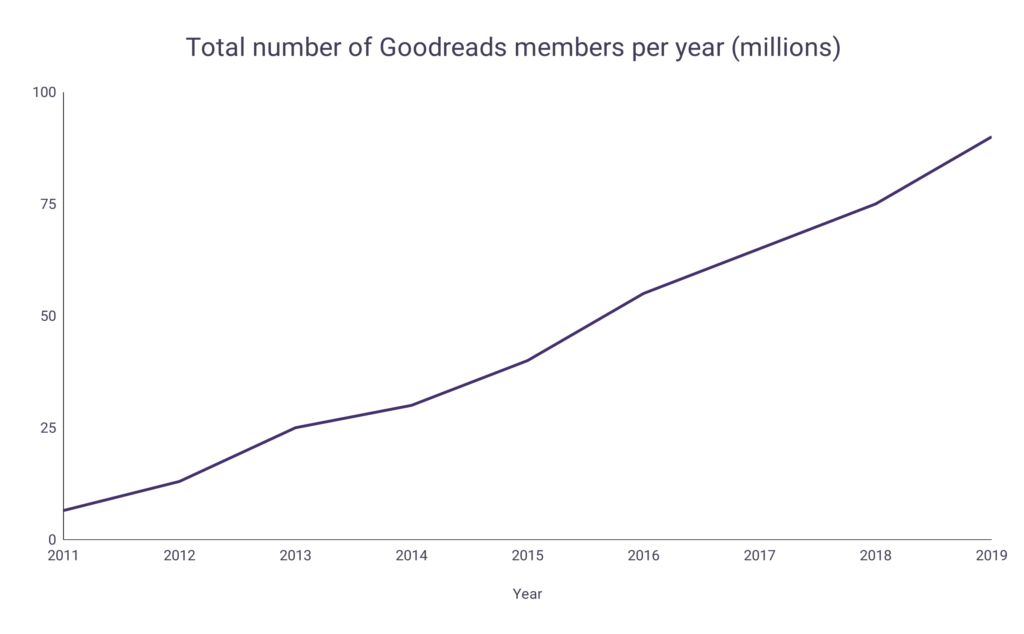
- More than 120 million members use the Goodreads platform globally.
- On TikTok, videos that used the #BookTok hashtag had received 42 billion views as of 2022.
- Book-related Instagram content rose by 31% during Covid, as its influencers encouraged audiences to read.
- For YouTube, its most popular book vloggers have thousands of followers and often work alongside publishers to create publicity through reviews and recommendations.
- If a book is mentioned by a publisher’s Twitter account, it will receive higher engagement than books mentioned by non-publishers.
Impact of technology in publishing on the environment
The manner in which books are manufactured, published, distributed, sold and read can have profound impacts on the environment. The increased importance of digital technologies such as print-on-demand, e-readers, ebooks and audiobooks have become key environmental drivers of change for the publishing industry.
- Almost 10% of global reading is done on digital devices, a number that is constantly growing.
- By adding together the emissions generated by electronic devices needed to browse the web, digital publishing is greatly more impactful than other industries.
- A Kindle device produces around 168 kg of CO2 during its entire lifecycle.
- By comparison, purchasing three physical books a month for over the course of four years produces around 1,074 kg of CO2.
- Modern print-on-demand services allow publishers and authors to print when copies have been ordered instead of in advance, which saves on cost and prevents waste.
Impact of social media on publishing
The rise and popularity of social media has disrupted the publishing industry, allowing authors, publishers and consumers to communicate in a more direct fashion. Book readers are now able to easily give opinions that influence the direction of the industry, which enables publishers and authors to better identify new opportunities.
- As of 2022, TikTok’s #BookTok hashtag had received more than 42 billion views.
- The previous year, 80% of the best selling UK YA book titles were driven by the trend.
- The Goodreads social book catalog website boasts more than 120 million members worldwide.
- This has helped it become the most favored digital book database for readers.
- Through the Instagram platform, book-related content rose 31% during Covid-19 as influencers encouraged followers to read.
A graph is given below to show Goodreads’ total number of members per year:
Impact of books on society
Books have long been considered a fundamental cornerstone of society, from being influential at all stages of a person’s education to being a go-to leisure activity. Their continued usage across different formats provides a range of outstanding benefits, positively impacting the education, health and social lives of readers around the world.
- Reading for 6 minutes can reduce a person’s stress levels by 66.67%.
- People who enjoy reading in their free time are 28% less likely to suffer from depression.
- For children, increased time spent leisure reading is positively correlated with improved overall lifetime achievement.
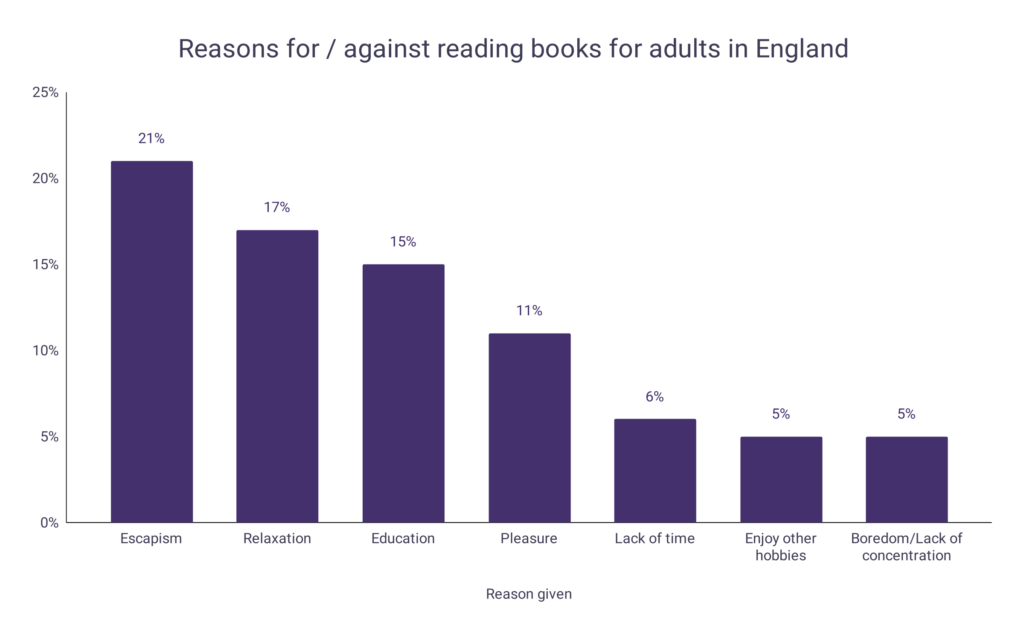
- The most popular reason for adults to read books in England was escapism (21%).
- However, the most common reason not to read books was a lack of available time (6%).
A graph is given below to show the responses given by adults in England for / against reading books:
Book publishing is shaped by technology, culture, and the way readers consume language and word games reflect all those same shifts. WordsRated’s Wordle Solver is updated every day for Wordle fans, and we publish hints for today’s Connections and today’s Wordle. Our Spelling Bee answers are also published daily for vocabulary-focused players.
Impact of libraries on book publishing
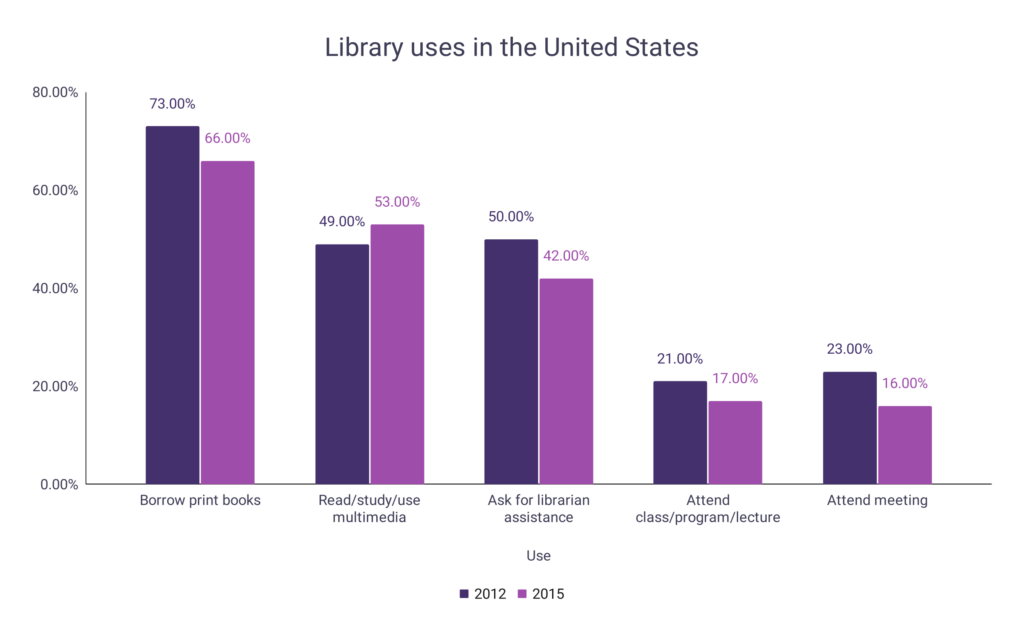
For book publishing, the impact of libraries can be seen both as beneficial and detrimental to the industry. Whilst libraries are able to encourage people to read and also facilitate new readers, publishers lament a reduction in sales revenue as their book copies can be checked-out multiple times from libraries instead of purchased.
- Through the use of libraries, US citizens are able to save 3.5 times the earnings of US trade publishers which would ordinarily be spent on books.
- Estimates suggest that 90% of circulated library books are trade books.
- During the lifetime of a library book, it can be checked out by readers between 40 to 80 times in total.
- Per capita in the US, book borrowing has doubled since the 1960s.
A graph is given below to show the main reasons for using libraries in the United States:
Impact of book publishing on film industry
Books have provided the original source material for many of the highest-grossing movies of all time. Fiction books as part of a series tend to generate the most success, which has led to the film industry favoring the production of titles that are based on publications from the category.
- More than 70% of the top 20 grossing films worldwide are based upon books.
- Financially, films that are book adaptations generate 53% more revenue than original screenplays.
- From 2007 to 2016, films adapted from books grossed $22.5 billion worldwide.
- Publishers are now able to anticipate boosts in income from additional book sales after the release of a film adaptation of their titles.
- Film adaptations can notably boost a book’s Goodreads popularity and increase its ratings by more than 1,000%.
A graph is given below to show the top 5 movie series based on books by gross revenue worldwide:

Impact of covid-19 on book publishing
- The US publishing industry generated $29.33 billion in 2021, a 12.3% increase over the previous year.
- There were 825.7 million total US book units sold during Covid in 2021, an 8.9% increase over the previous year.
- US bookstores saw an 11.3% sales decline in 2020 compared with the previous year.
- However by October 2021, sales at bookstores were up nearly 40% compared to the same 2020 period.
- This was partly due to a greater adoption in online sales and the opening of new stores for both independents and chains.
- For the first time ever, online sales made up around 50% of trade sales.
- 71.4% of authors in the US reported drops in income since the start of the pandemic.
- Those who earned less lost 49% of their regular earnings on average.
- 24.5% of US authors applied for unemployment benefits or Covid-19 relief support schemes.
- Alongside Covid-19 itself and new supply chain issues, book distributors were affected by a high resignation rate from warehouse workers in the US.
- During 2020, 30% of people read more books or listened to more audiobooks than in previous years.
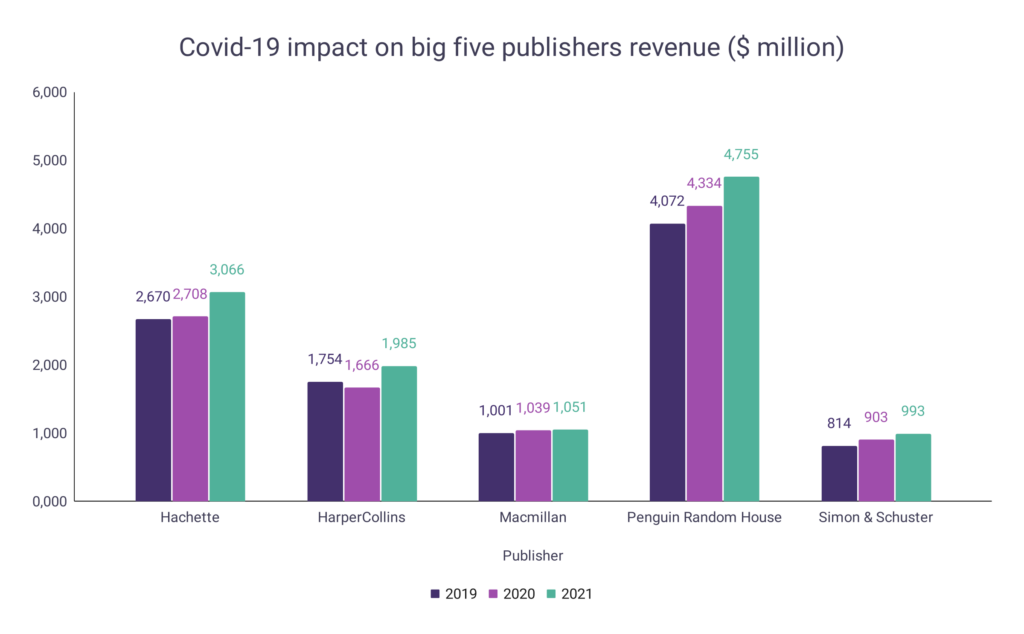
Covid-19 impact on big five publishers revenue
For the Big 5 publishing companies, total revenues increased over the three-year period from 2019 to 2021. Although the impact of Covid-19 was hard on many individuals and other businesses, the Big 5 continued to make revenue increases.
- Hachette’s revenue increased 14.83% to $3.07 billion over the period.
- HarperCollins’ revenue increased 13.17% to $1.99 billion over the period.
- However, the company did register a drop in revenue from 2019 – 2020, the only Big 5 publisher to do so.
- Macmillan’s revenue increased 5% to $1.05 billion over the period.
- Penguin Random House’s revenue increased 16.77% to $4.76 billion over the period.
- Simon & Schuster’s revenue increased 21.99% to $993 million over the period.
| Year | Hachette | HarperCollins | Macmillan | Penguin Random House | Simon & Schuster |
| 2021 | $3,066 | $1,985 | $1,051 (est.) | $4,755 | $993 |
| 2020 | $2,708 | $1,666 | $1,039 | $4,334 | $903 |
| 2019 | $2,670 | $1,754 | $1,001 | $4,072 | $814 |
A graph is given below to show the impact of Covid-19 on the revenue of the Big 5 publishers:
Covid-19 impact on educational publishing
During the Covid-19 pandemic, many schools, colleges and universities moved to online learning. Coinciding with this, educational publishers looked to embrace digital publishing, resulting in its major global market growth.
- US educational publishing grew by 15.2% during 2021 after dropping by 9% in 2020.
- The global digital educational publishing market is expected to grow 87.42% to $29.5 billion by 2027.
- Texts in digital educational material globally are expected to grow 114.72% to $11.38 billion by 2027.
- The global interactive textbooks market is expected to grow 16.5% to $2.3 billion by 2027.
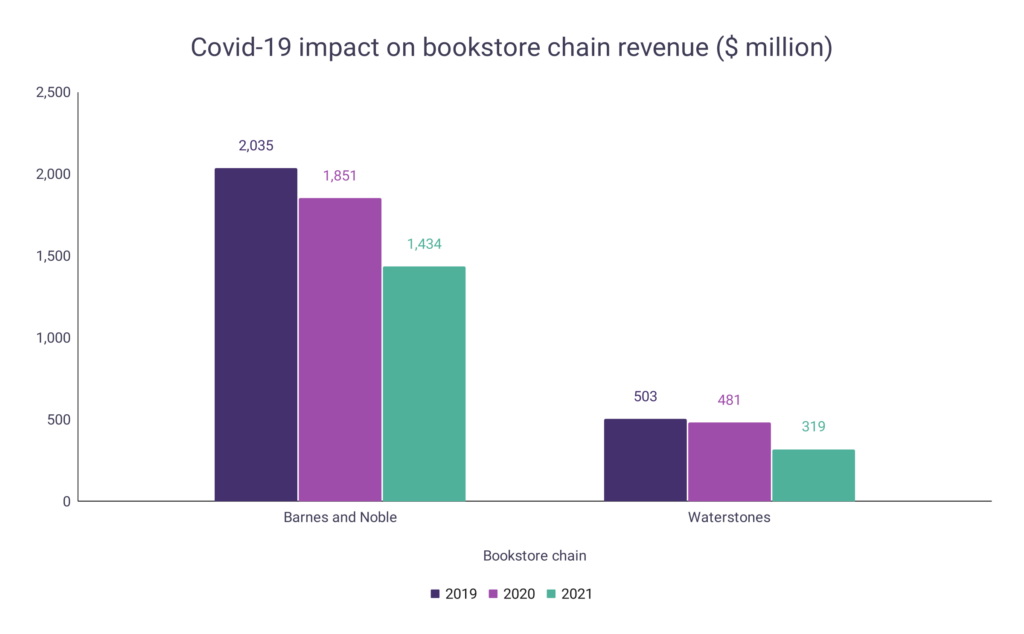
Covid-19 impact on bookstore chain revenue
The largest bookstore chains in the US and the UK however were hugely impacted by Covid-19. Health and safety measures such as increased social distancing implemented over the period greatly reduced in-store sales.
- Barnes and Noble’s revenue decreased 29.53% to $1.43 billion over the period.
- The company’s revenue dropped by $417 million in 2021 alone.
- Waterstones’ revenue decreased 36.58% to $319 million over the period.
- The company’s 2021 revenue was a drop of $162 million from the previous year.
| Year | Barnes and Noble | Waterstones |
| 2021 | $1,434 | $319 |
| 2020 | $1,851 | $481 |
| 2019 | $2,035 | $503 |
A graph is given below to show the impact of Covid-19 on the revenue of bookstore chains:
Covid-19 impact on author income
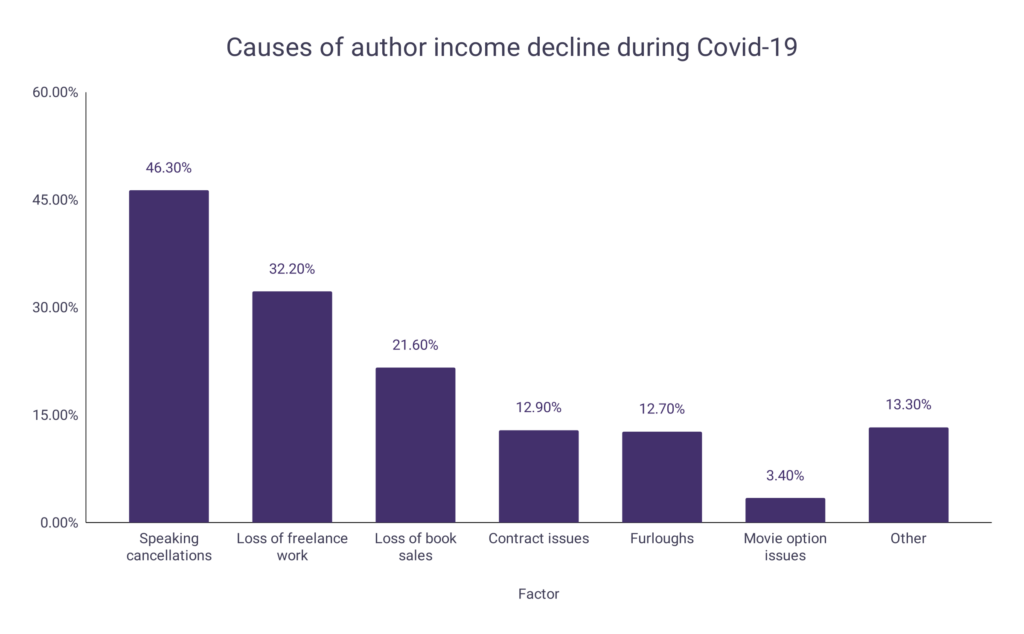
Authors also felt the financial effects of Covid-19, with the vast majority reporting that their income had fallen. Those that suffered drops in earnings found their income was almost halved, leading around 1 in 4 authors to apply for financial support schemes.
- The most common factor contributing to a drop in income for authors during Covid-19 was speaking cancellations (46.3%).
- 32.2% of authors with reduced incomes reported having a loss of freelance work.
- 21.6% of authors with reduced incomes reported having an overall drop in book sales.
- Contract problems, furloughs and issues with movie options made up the remaining factors.
| Factor | Percentage |
| Speaking cancellations | 46.3% |
| Loss of freelance work | 32.2% |
| Loss of book sales | 21.6% |
| Contract issues | 12.9% |
| Furloughs | 12.7% |
| Movie option issues | 3.4% |
| Other | 13.3% |
A graph is given below to show the causes of author income declines during Covid-19:
Covid-19 impact on book publishing industry events
- During 2020, author tours, conferences and fairs became hosted virtually as an industry standard practice to reduce the spread of Covid.
- Although there was a hope for these events to return to in-person attendance during 2021, most events continued in a virtual format at the start of the year.
- Bookstores began hosting live author appearances (outside or indoor with limited masked attendances) during the summer months.
- However, towards the winter new variants continued to appear, affecting the continuation of in-person events.
Covid-19 impact on the book publishing supply chain
The pandemic contributed to major supply chain problems across almost all industries, especially those with a dependence on overseas sellers. Book publishing was no exception and had to respond quickly by implementing a range of new measures.
Causes of supply chain problems
- In US book publishing and manufacturing, shortages of truck drivers, congested ports and high freight container prices made it difficult for the industry to deliver books in time, especially over the festive season.
- Furthermore, companies with large warehouses, such as Amazon and Ingram, suffered from widespread shortages of labor.
- Companies struggled to find skilled workers whilst simultaneously dealing with ongoing paper shortages, resulting in printing capacity issues.
Solutions to supply chain problems
- To counter these problems, publishers looked to focus on delivering frontlist titles on time, delaying their other releases.
- Publishers also looked to move more printing back to the US and encouraged a higher use of print-on-demand services.
- The development and further implementation of technology and automation are believed to be the best long-term solutions to address supply chain issues by experts in the industry.
Impact of book publishing on environment
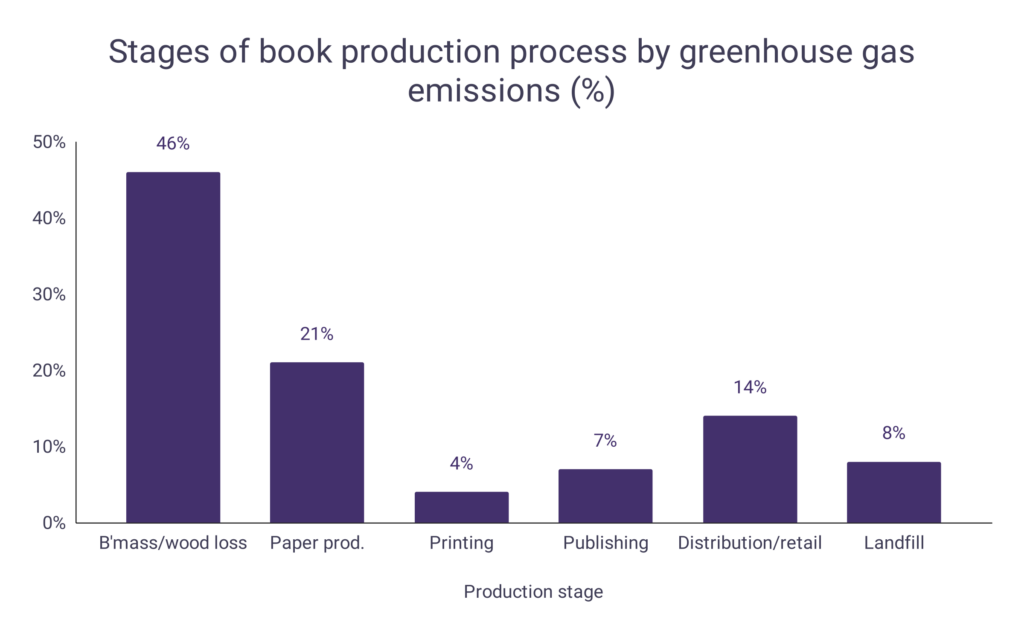
The book publishing industry produces a staggering impact on the environment due to its manufacturing processes, logistics, energy usage and physical waste created. In recent years, an increased global focus on sustainability has encouraged the industry to re-think its approach to the environment and become greener as a collective.
- Across the globe, the book production process emits more than 40 million metric tons of CO2.
- From pulp and paper alone, the process of book publishing produces the third-largest amount of industrial greenhouse gas emissions.
- Annually, more than 16,000 truckloads of unread books are wasted.
- An estimated 10 million trees are killed to produce books that are unread during their lifetime, before being destroyed.
- 22.5 paper books could be purchased by a consumer before it would be more environmentally viable to use a Kindle device.
A graph is given below to show each stage of the book production process by its greenhouse gas emissions produced:
FAQ
Is the book publishing industry dying?
- Although the book publishing industry has had to undergo huge changes in recent years, the book publishing industry is not fading away.
- The rise in ebooks and audiobooks have created new publishing opportunities to meet the demands of consumers, alongside the continued desire for printed books.
- Traditional publishing houses now face increased competition from self-publishing platforms and online retailers, however the necessity for books across a range of formats remains.
How have publishers adapted to new trends?
- The book publishing industry has attempted to adapt to new trends by making itself more approachable and aligned with consumers.
- Digital publications now make up a large portion of book sales to satisfy readers who prefer using electronic devices to read or listen to books.
- Social media trends are increasingly monitored and analyzed to promote titles and anticipate new publishing opportunities.
- Furthermore, publishing companies are now more attentive and focused on green initiatives to reduce their carbon footprint.
What will happen to print books?
- Although there were many predictions that print books would decrease in popularity, they still remain a popular format for children, young adults and adults alike.
- Printed books are able to retain their popularity as readers notice they experience an increase in concentration when compared to reading on devices.
- However, digital formats are still on the rise and their market share is expected to grow alongside printed formats.
- Printed and digital book formats can be seen to complement each other, providing a variety in publications for readers with different tastes.
How does technology impact authors?
- Authors now have more options available to them when looking to publish their books.
- Self-publishing is more straightforward and can give them more control over the success of their work, without dependence on publishing companies.
- For the marketing of their publications, they are able to use social media to find audiences that match their genre and start to build a following.
- By building up a following and a personal brand, larger publishers may look to sign them later down the line.
How does technology impact publishing companies?
- Publishing companies now need to focus on publishing across both physical and digital formats.
- Physical formats have been affected by a push for the industry to be more sustainable and as such, better manufacturing developments are now utilized.
- Social media has allowed publishers to communicate directly or indirectly with other people and companies within the industry in order to build connections.
- By using data gathered from social media, publishers can also anticipate industry trends and produce titles that more closely align with the needs of consumers.
How does technology impact book consumers?
- Book consumers now feel they can make their voices heard through the use of social media, especially for book reviews using the Goodreads platform.
- In addition, many consumers enjoy following experts within the industry through different platforms.
- Consumers may even contribute by adding book-related content and creating a following themselves.
- Insights from consumers will even be taken into consideration within the film industry when deciding which books to adapt into movies.
- New developments in technology have led to the increase in digital formats such as ebooks and audiobooks, which have proved to be popular with consumers.